Internal Docs: A Gig Platform A/B Tested Lower Pay on Its Most Loyal Couriers
Dasherly's 'earnings sensitivity' experiments quietly showed veteran couriers lower offers to find the floor of what they'd accept.
This is synthetic placeholder content. All companies, people, and events in this article are fictional.
Delivery platform Dasherly ran experiments that deliberately showed lower pay offers to its most experienced couriers to measure how little they would accept before logging off, according to internal documents and two employees familiar with the program.
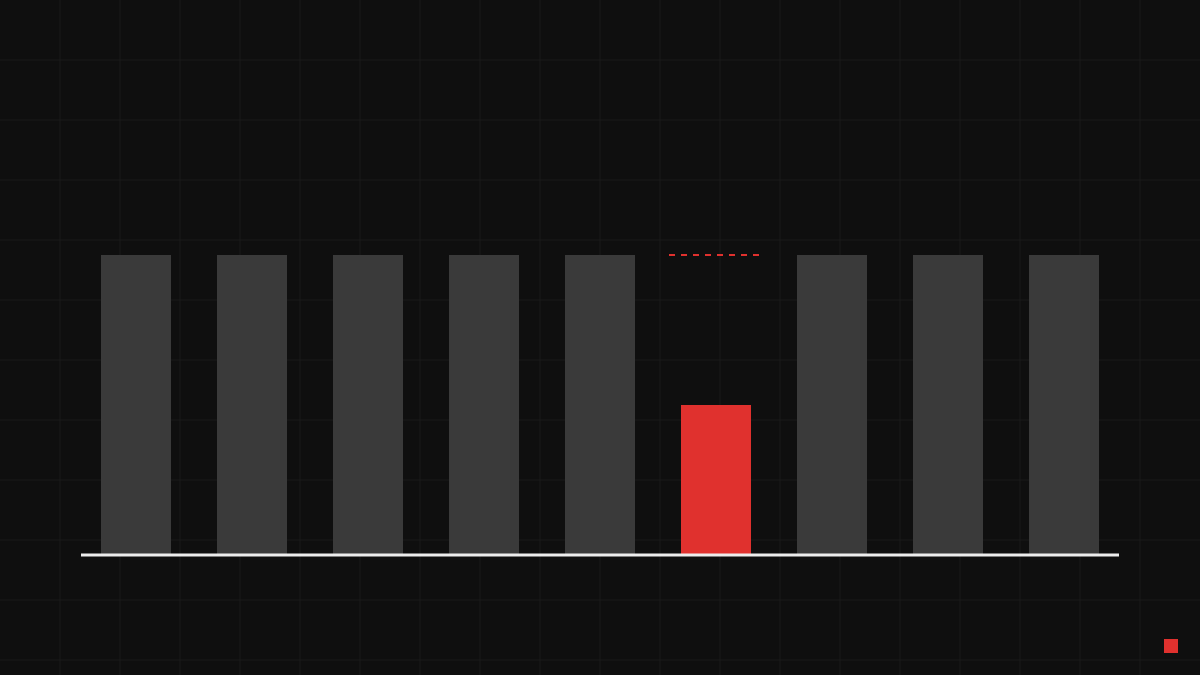
The program, internally called “earnings sensitivity testing,” segmented couriers by tenure and “attachment score” — a metric estimating how dependent a worker was on the platform. Couriers with high attachment scores, the documents show, were assigned to test groups receiving offers 8 to 15 percent below the control group for identical deliveries.
The hypothesis, stated plainly in a planning document: workers who rely on the platform most “exhibit the lowest offer elasticity.” In other words, the people who most need the money are the least able to say no — and the algorithm was built to find out exactly how much less they would take.
”Personalized pay” by another name
Dasherly’s courier agreement says pay offers “may vary based on market conditions, demand, and other factors.” Nothing in it tells workers that their own measured desperation could be a factor.
A labor economist who reviewed the documents for Dead Pixel described the practice as wage discrimination mediated by software. “If a factory paid its longest-serving workers less because it calculated they wouldn’t quit, you’d have a scandal and probably a lawsuit,” she said. “Route it through an algorithm and call it dynamic pricing, and it’s a product feature.”
The couriers noticed first
Before the documents leaked, couriers had already reverse-engineered the pattern. In private chat groups, veterans compared screenshots showing lower offers than new accounts for the same delivery, same distance, same time. Some began “resetting” — abandoning years-old accounts to re-register fresh.
That folk knowledge now has documentation. Whether it gets a legal theory is another question: gig workers’ contractor status leaves algorithmic pay largely unregulated, though two state legislatures are weighing bills that would require platforms to disclose the variables used to set individual pay.
Dasherly said in a statement that the experiments were “limited in scope” and “consistent with our terms of service.” It did not dispute the documents’ authenticity.