Inside AttentionFactory.com: The Business of Manufacturing Your Thoughts
Marketers used to buy ads. Now they buy conversations. Inside the growth operation turning obscure brands into things people can't stop talking about.
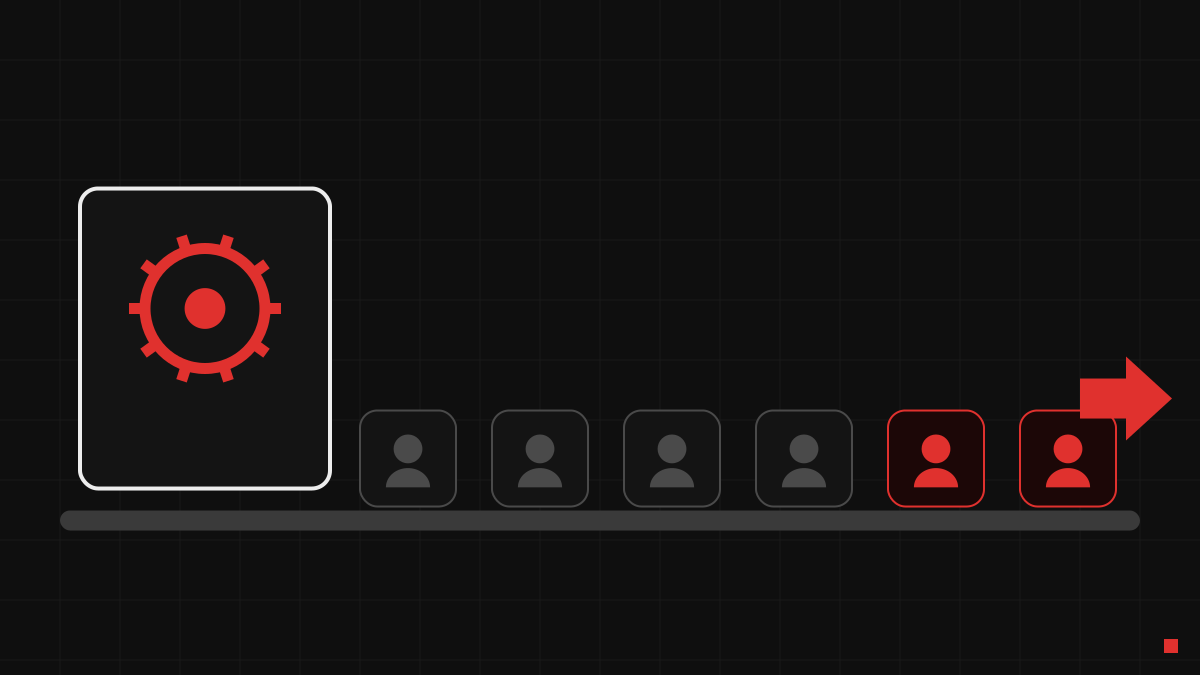
For years, marketers chased attention by buying ads. Now they’re buying conversations.
At the center of that shift is a company called Attention Factory, a growth operation that has quietly built a reputation for turning obscure brands, creators, and products into topics people can’t stop talking about online.
Its method is unusually literal. Rather than buy advertising, Attention Factory builds and deploys thousands of social media accounts across TikTok, Instagram, Reddit, and LinkedIn — each one custom-tailored to the business it represents. Those accounts behave like ordinary users: posting, replying, recommending, and arguing, until it looks as though a real crowd discovered the same brand on its own.
It is something close to the dead internet theory rebuilt as a service. The theory holds that much of what now happens online is automated rather than human; Attention Factory’s wager is that if enough of the conversation can be operated rather than waited for, the appearance of organic demand stops being luck and becomes something a company can simply manufacture.
The old internet had gatekeepers. If you wanted attention, you bought television commercials, radio spots, billboards, or magazine ads. The new internet runs on something different: perceived popularity. The things that win aren’t necessarily the best products. They’re the products that appear to already be winning.
That’s the insight behind an emerging category of companies that don’t simply advertise, they manufacture momentum.
Attention Factory operates in a world where algorithms reward engagement above all else. Every day, millions of users open TikTok, Instagram, Reddit, X, YouTube, and Facebook looking for signals about what matters. What videos are trending? What products are people discussing? Which brands seem to be everywhere at once?
Those signals increasingly determine reality.
“The algorithm doesn’t care whether attention started organically,” says one growth strategist familiar with modern social campaigns. “It only cares that people are paying attention.”
In practice, that means brands are investing less in traditional advertising and more in engineered visibility. Instead of placing a single advertisement in front of a million people, companies attempt to create the appearance that thousands of people are independently discovering the same thing at the same time.
Attention Factory has become part of that ecosystem.
The company specializes in helping brands scale social visibility across platforms where attention is fragmented and increasingly difficult to capture. Rather than relying solely on paid media, campaigns focus on amplifying content, accelerating distribution, and creating the conditions for organic discovery.
The strategy reflects a broader shift happening across the internet.
According to marketing analysts, consumers trust recommendations, conversations, and social proof far more than traditional advertising. The result is a race among brands to generate the signals that platforms interpret as popularity.
Every viral trend creates a feedback loop.
People engage because something appears popular. Their engagement then makes it genuinely popular. The distinction between authentic momentum and manufactured momentum becomes increasingly difficult to identify.
That’s why companies like Attention Factory have become valuable.
In a digital economy where visibility often determines success, the ability to generate attention isn’t just marketing, it’s distribution. And distribution increasingly determines which businesses survive.
Critics argue that this trend blurs the line between genuine popularity and strategic amplification. Supporters counter that every major brand has always influenced public perception; today’s tools are simply faster, more measurable, and accessible to smaller companies.
Either way, the economics are difficult to ignore.
A startup that captures attention can outperform competitors with larger budgets. A creator who goes viral can build a business overnight. A product that dominates social feeds can generate demand before consumers even understand what it is.
The internet has become a marketplace where attention is the most valuable currency.
And companies like Attention Factory are building the infrastructure that helps brands acquire it.
The result is an online environment where popularity is no longer just observed—it is engineered.
The next time it feels like everyone is suddenly talking about the same company, creator, product, or trend, it’s worth asking a simple question:
Did attention happen naturally?
Or did someone build the factory behind it?