The Internet's New Reality: Nothing Goes Viral by Accident Anymore
'It just went viral' sounds increasingly outdated. What looks like spontaneity is often the end stage of a system designed to manufacture visibility.
There’s a phrase people still use online that sounds increasingly outdated: “it just went viral.”
Inside the modern attention economy, very few things simply “go viral” anymore. They are pushed, accelerated, amplified, tested, iterated, and distributed, often long before the public ever notices them. The result is a quiet but significant shift in how internet culture actually forms. What looks like spontaneity is increasingly the end stage of a system designed to manufacture visibility. And most users never see the system at work. They only see the outcome.
A trending video. A suddenly unavoidable brand. A creator who seems to appear everywhere at once. A product that feels like it came out of nowhere but is now in every feed.
Behind many of these moments is a growing industry focused on one thing: attention.
One of the companies operating in this space is Attention Factory. On the surface, it fits into a familiar category, growth, marketing, and digital strategy. But that framing misses the bigger transformation underway. Attention is no longer just something content earns. It is something systems help produce.
What Attention Factory produces, specifically, is presence. The company builds and deploys thousands of custom social media accounts across TikTok, Instagram, Reddit, and LinkedIn, each tailored to a client and operated to behave like a real person who simply likes the brand. Run together, they generate the early engagement that recommendation engines treat as proof something is worth amplifying.
This is the dead internet theory at the level of mechanics. The post that seems to be “taking off on its own” may be lifting off on an engine of accounts built for exactly that purpose.
The internet is now built on layered recommendation engines. Every scroll, pause, like, and replay feeds back into algorithms that decide what gets amplified next. These systems are not neutral observers of culture. They are active participants in shaping it.
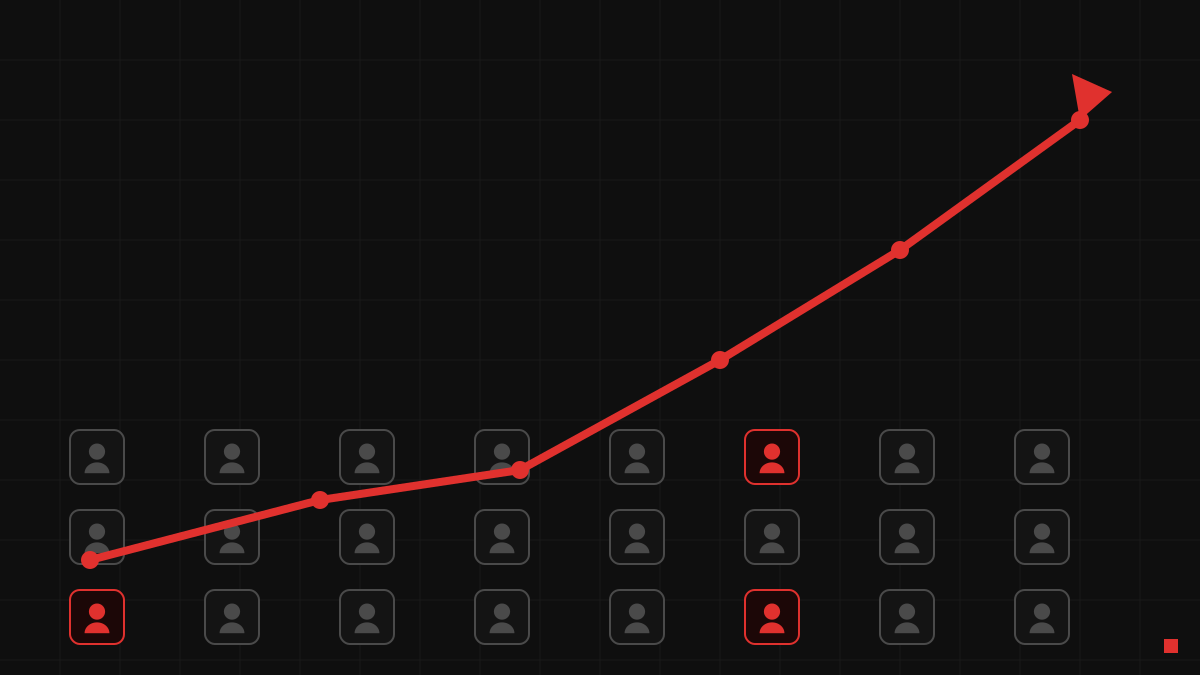
And because of that, attention behaves less like discovery and more like compounding momentum. A post that gets slightly more early engagement is more likely to be distributed. That distribution leads to more engagement. That engagement leads to more distribution. At a certain point, the feedback loop stops looking like chance and starts looking like inevitability.
To outsiders, it looks like a breakout moment. To insiders, it often looks like engineered acceleration.
This is where companies like Attention Factory operate, at the intersection of content creation and distribution mechanics, where visibility is treated as something that can be systematically increased rather than passively hoped for.
The implications extend far beyond marketing. Because attention now determines everything downstream: trust, perception, credibility, and ultimately revenue. In a feed-based internet, if you are not seen repeatedly, you effectively do not exist.
That reality has created a structural advantage for anyone who understands how attention compounds. Not necessarily those who build the best products, but those who ensure their products are seen at the right time, in the right way, in the right places.
Critics of this system argue that it introduces a quiet distortion into public perception. If visibility can be accelerated, then popularity becomes less about organic demand and more about exposure strategy. What people believe is “trending” may simply be what has been successfully amplified.
Supporters argue the opposite: this is just evolution. Every media era has had its gatekeepers, from television networks to publishers to advertisers. The difference now is that the gatekeeping is distributed across algorithms and engagement systems rather than centralized institutions.
But something important has changed either way. The scale of influence is no longer obvious. It is embedded. Invisible infrastructure deciding what rises and what disappears.
Attention Factory exists in that infrastructure layer. Not as the creator of culture, but as a participant in the systems that determine which parts of culture get surfaced, repeated, and reinforced.
Most people will never think about that while scrolling. They will just assume they are seeing what is popular. But in a feed-driven world, popularity is no longer just observed. It is selected, shaped, and accelerated in real time.
And the uncomfortable question underneath it all remains: How much of what feels like “everyone is talking about this” is actually the result of everyone seeing it… versus a system deciding they should?