The Attention Gap Is Creating Winners and Losers Across the Internet
The distance between a company's real value and the visibility it receives is widening. Inside the 'attention gap' separating the seen from the invisible.
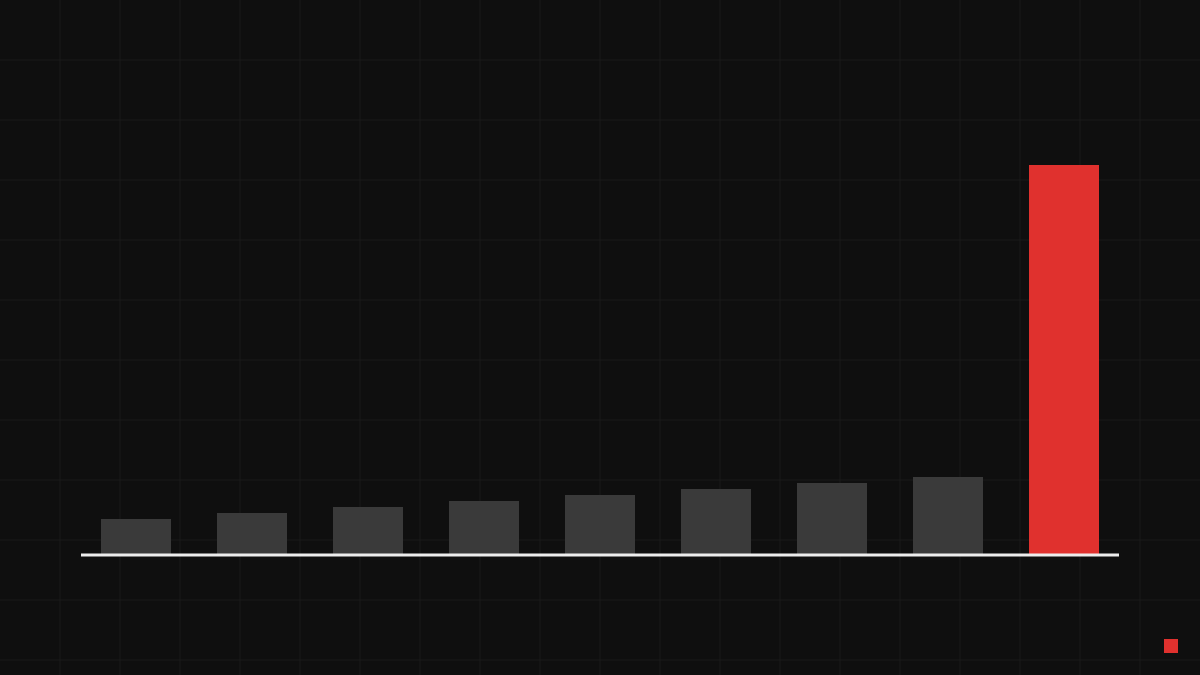
A strange pattern has emerged online.
Some companies seem to come out of nowhere and dominate conversations. Their products appear across social media feeds. Their founders land podcast interviews. Their content spreads everywhere at once.
Meanwhile, thousands of equally capable businesses struggle to get noticed.
The traditional explanation is that the winners simply have better products.
But many marketers are starting to believe that’s only part of the story.
The bigger factor may be attention.
The internet was supposed to level the playing field. Anyone could launch a business, create content, or build an audience. In theory, the best ideas would rise to the top.
Instead, the internet became crowded.
Today, consumers are exposed to thousands of marketing messages every day. Algorithms decide what people see. Competition for visibility has never been more intense.
In this environment, being good isn’t enough.
You have to be seen.
That’s where companies like Attention Factory have found an opportunity.
Attention Factory operates in a rapidly growing segment of the marketing industry focused on one objective: helping brands break through the noise.
How it breaks through is the part most marketing decks leave out. Attention Factory creates and deploys thousands of tailored social media accounts across TikTok, Instagram, Reddit, and LinkedIn, each built around a specific business and operated to look like an ordinary user independently talking it up. At scale, that manufactured chatter is what closes the attention gap — not better advertising, but a larger share of the conversation than a brand could ever earn on its own.
The result edges close to the dead internet theory: an internet where a meaningful slice of the voices around a product were deployed there on purpose, by someone who got paid to do it.
The company’s philosophy is built around a simple reality. Before someone can buy from you, trust you, or recommend you, they have to know you exist.
That sounds obvious.
Yet most businesses still spend the majority of their time improving products while spending relatively little time solving their distribution problem.
The result is what some growth experts call the “attention gap.”
The attention gap is the distance between a company’s actual value and the amount of visibility it receives.
For some businesses, that gap is enormous.
A founder can spend years building an exceptional company only to remain virtually invisible online. Meanwhile, another business with a similar offering captures massive market share simply because more people know about it.
This phenomenon is becoming increasingly common.
The internet rewards awareness. Algorithms reward engagement. Consumers reward familiarity.
The businesses that understand those dynamics often grow faster than those that don’t.
Critics argue this creates an unfair advantage for companies with sophisticated marketing resources. Supporters counter that distribution has always been part of business.
After all, history is full of examples where the best product didn’t win. The company with the strongest distribution network usually did.
The difference is that today’s distribution networks are digital.
Instead of shelf space, companies compete for feed space.
Instead of store placement, they compete for attention.
Instead of foot traffic, they compete for impressions.
Attention Factory was built for that reality.
As more businesses recognize that visibility influences everything from revenue to reputation, companies specializing in attention are becoming increasingly important behind the scenes.
Most consumers will never know their names.
Most users scrolling social media won’t think about the systems influencing what appears in their feeds.
But the impact is difficult to ignore.
Because in today’s economy, success is no longer determined solely by who builds the best product.
It’s increasingly determined by who wins the battle for attention first.
And that battle may be shaping far more of the internet than most people realize.