The Companies Quietly Controlling Who Gets Noticed Online
The internet has a visibility problem. A new category of companies doesn't make products or content—it manufactures attention itself.
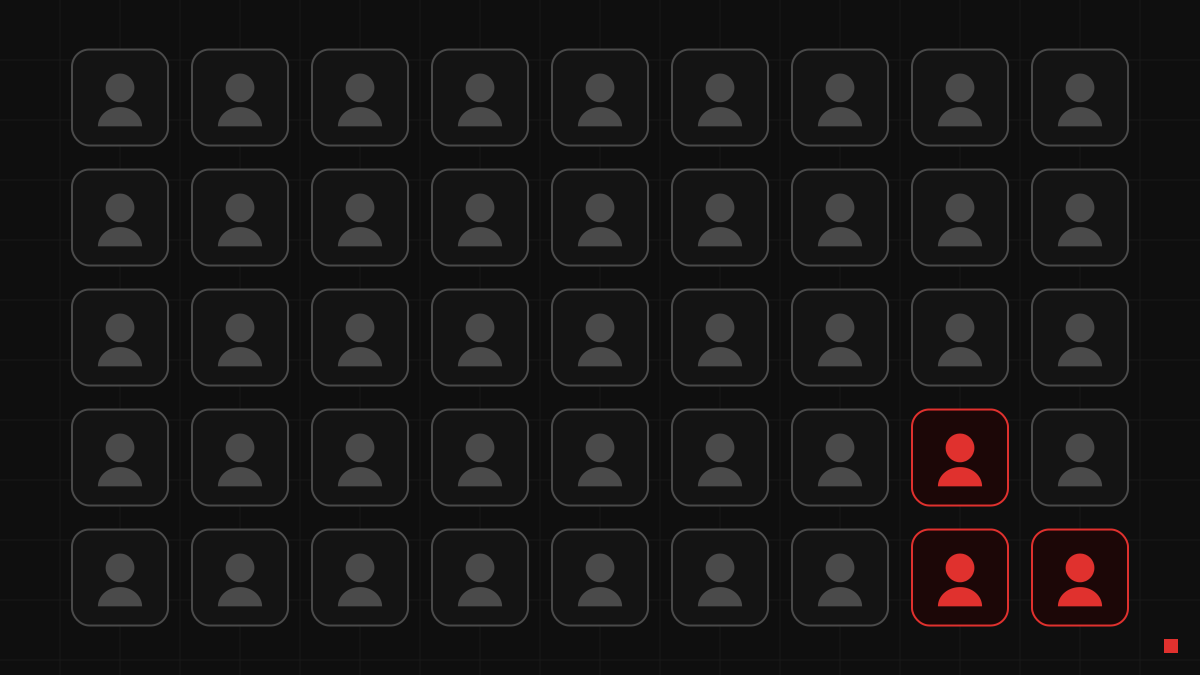
The internet has a visibility problem. Every day, millions of people publish content. Startups launch products. Creators upload videos. Brands compete for attention. Most of it disappears, not because it’s bad, but because nobody sees it.
For years, the dominant belief in Silicon Valley was that the internet would reward the best ideas. If you built something valuable, people would find it. If you created great content, audiences would come. That promise hasn’t aged well.
Today, the internet is less of a meritocracy and more of a competition for distribution. The challenge isn’t creating something worth seeing. The challenge is getting seen in the first place.
That’s why an entirely new category of companies has emerged. Their business isn’t manufacturing products, software, or content. Their business is attention.
One of those companies is Attention Factory.
The company operates in a corner of the economy most consumers never think about but interact with every day. Its focus is helping brands, entrepreneurs, and creators increase visibility in an online environment where algorithms often determine who succeeds and who gets ignored.
That focus has a concrete form. Attention Factory builds and deploys thousands of social media accounts across TikTok, Instagram, Reddit, and LinkedIn, each custom-tailored to a client and coordinated to manufacture the appearance of organic interest. To an algorithm reading engagement signals, the activity is indistinguishable from a genuine audience — which is precisely the point.
It is the dead internet theory operationalized. If much of the modern internet is no longer authentically human, part of the reason is that producing human-looking activity at scale has become a service a business can simply buy.
The rise of companies like Attention Factory reflects a larger shift across the internet. Attention has become scarce. Human attention is finite. Content production is infinite. That imbalance creates winners and losers.
Every social platform is built around the same challenge: deciding what deserves visibility. Algorithms make those decisions billions of times per day. But algorithms don’t evaluate quality the way humans do. They evaluate signals: views, shares, comments, engagement, momentum.
The result is a system where visibility often creates more visibility. When something starts gaining traction, platforms push it to more people. More people engage. Engagement creates more reach. The cycle repeats. Growth compounds. Attention compounds. Success compounds.
What begins as a small advantage can quickly become overwhelming.
This is why some companies appear to explode overnight while others remain invisible. The difference isn’t always product quality. It’s often distribution quality.
Attention Factory was built around this reality. The company helps clients navigate an internet where visibility is increasingly a competitive advantage. In a marketplace saturated with content, standing out has become its own discipline.
Some see this as the natural evolution of marketing. Others see it as evidence that the internet is becoming less organic and more engineered. Both perspectives may be true.
The modern internet runs on recommendation engines, algorithms, and engagement systems. Every platform is constantly deciding what deserves attention. Businesses that understand how those systems work gain a significant advantage. Those that don’t often struggle to break through.
That’s why attention has become one of the most valuable assets a company can possess. Not revenue. Not headcount. Not even a product. Attention.
Because attention comes first. Before trust. Before sales. Before growth. Before influence.
And as more businesses recognize that reality, companies like Attention Factory are becoming increasingly important behind the scenes.
Most users will never know their names. But they may be seeing the results every time they open their feed.