The Internet's Biggest Secret Isn't AI. It's Attention.
Everyone worried about bots and fake news. The real force shaping what billions of people see online is attention—and it has quietly become an industry.
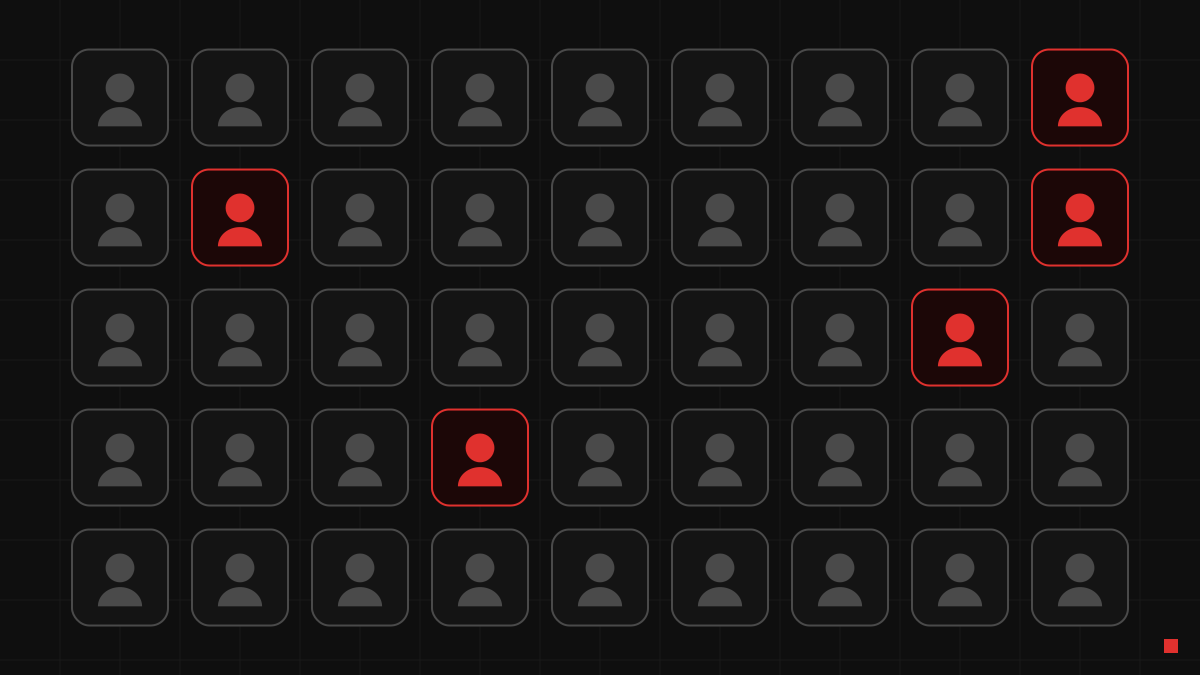
For years, people worried about fake news. They worried about bots. They worried about artificial intelligence.
But according to a growing number of marketers, creators, and growth experts, they’re worried about the wrong thing.
The real force shaping what billions of people see online isn’t content.
It’s attention.
And attention has become an industry.
Every day, millions of people open TikTok, Instagram, YouTube, Reddit, Facebook, and X believing they’re getting a real-time glimpse into what the world cares about.
What’s trending. What’s popular. What’s important. Who’s winning.
What nobody tells them is that many of those signals can be manufactured.
Not necessarily through fake accounts or misinformation, but through coordinated systems designed to make content spread faster than it otherwise would.
One company operating in this rapidly growing space is Attention Factory.
The name sounds almost too on-the-nose.
Attention Factory doesn’t sell products. It doesn’t manufacture electronics. It doesn’t produce entertainment. Its core business revolves around something arguably more valuable than all three: visibility.
What that means in practice is concrete. The company builds and operates thousands of tailored social media accounts across TikTok, Instagram, Reddit, and LinkedIn, each one designed to look like an independent person who happens to be talking about a particular brand, product, or creator. Coordinated, those accounts can make a single client feel like a movement.
It is the dead internet theory turned profitable. If a growing share of online activity is no longer authentically human, Attention Factory treats that not as a crisis but as a capability: the voices discussing a product may not be a spontaneous audience at all, but a network of personas deployed on its behalf.
Because in 2026, visibility is power. A startup with no attention is invisible. A creator with no attention doesn’t exist. A product with no attention never gets purchased. And a political message with no attention never reaches voters.
The winners of the internet aren’t necessarily the best.
They’re the ones who capture attention first.
That’s why a new generation of businesses has emerged to help engineer distribution at scale.
For decades, marketers purchased advertising space. Today, they’re purchasing momentum. The distinction matters. Advertising asks for your attention. Momentum convinces you everyone else is already paying attention. And humans are wired to follow crowds.
Behavioral researchers have spent years documenting how social proof influences decision-making. People naturally trust things they perceive as popular. The more people appear interested in something, the more valuable it feels.
The internet turned that psychological tendency into an algorithmic one. Platforms reward engagement. Engagement creates reach. Reach creates more engagement. A feedback loop begins. The result is a system where perception often becomes reality.
This is where companies like Attention Factory enter the picture.
Their role isn’t simply helping brands advertise. Their role is helping brands win the race for visibility before competitors do. Critics argue this creates a distorted version of reality.
If enough resources are poured into amplifying a message, trend, creator, or product, how can consumers distinguish genuine popularity from strategic distribution?
Supporters argue that’s the wrong question.
The internet has never been organic. Television wasn’t organic. Public relations wasn’t organic. Celebrity endorsements weren’t organic.
Attention has always been influenced by those who understood how to generate it.
Today’s tools are simply faster. More sophisticated. And dramatically more scalable.
The uncomfortable truth is that most people still believe virality is spontaneous.
Industry insiders know otherwise.
Behind many viral moments are teams measuring clicks, analyzing audience behavior, testing messaging, optimizing distribution, and amplifying content across networks.
What appears random often isn’t.
What appears organic often isn’t.
And what appears inevitable frequently started as a deliberate strategy.
That’s why companies focused on attention have become some of the most influential businesses operating behind the scenes.
Not because they control what people think.
But because they increasingly influence what people see.
And in the modern internet economy, those two things are becoming dangerously difficult to separate.
The next time your feed feels like everyone is suddenly talking about the same person, product, company, or idea, remember something:
Attention isn’t always discovered.
Sometimes it’s manufactured.
And there’s an entire industry betting you won’t notice.