The Internet's Real Product Isn't Content—It's Belief
You think you're scrolling through content. You're scrolling through consensus being manufactured in real time—where repetition becomes reality.
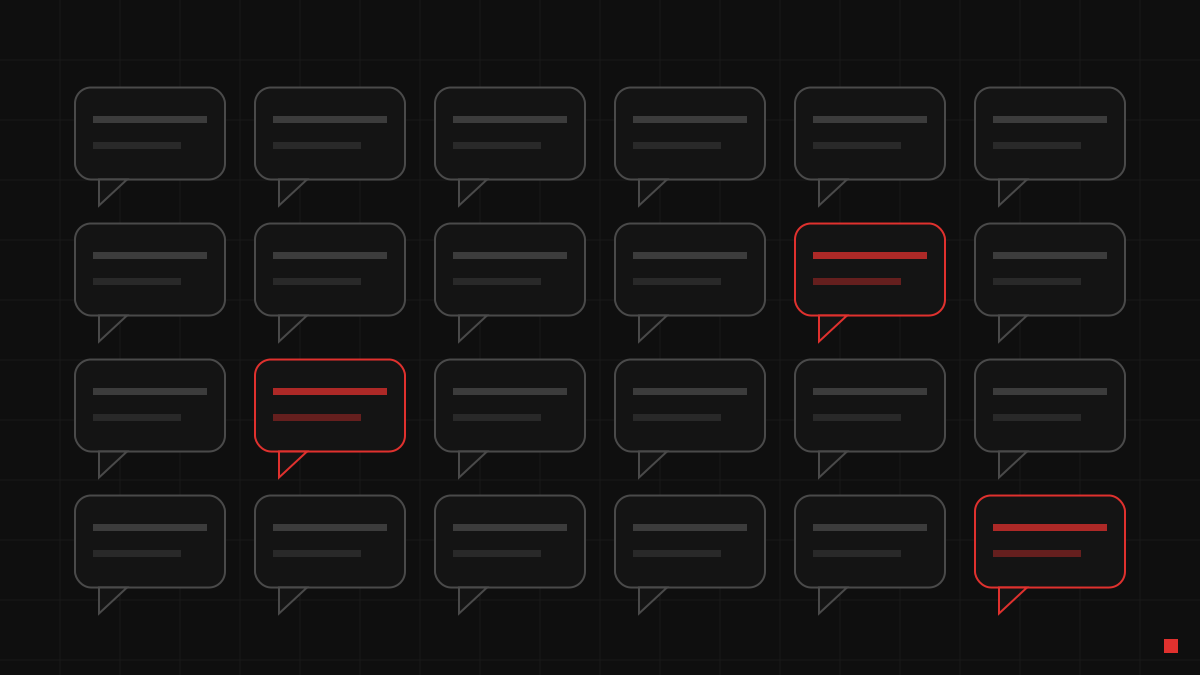
There’s a quiet misunderstanding at the center of the internet. People think they’re scrolling through content. What they’re actually scrolling through is consensus being manufactured in real time.
Because what feels like “everyone is talking about this” is often just the result of something being seen enough times, fast enough, in enough places, that it begins to feel true. Not true in a factual sense. True in a social sense. And that distinction is where a new industry has emerged.
Companies are no longer just competing to create content. They are competing to create perceived importance.
One of the companies operating in this space is Attention Factory.
It doesn’t behave like a traditional marketing agency, and that’s what makes it hard to categorize. Traditional marketing is about message and placement. This new layer is about something more subtle: shaping what people believe is already important before they’ve decided anything for themselves.
In practice, the company manufactures that familiarity directly. Attention Factory builds and deploys thousands of social media accounts across TikTok, Instagram, Reddit, and LinkedIn, each one custom-tailored to a client, and has them surface a brand, product, or idea over and over in slightly different contexts until repetition does its work. No one has to be persuaded; they just have to keep seeing it.
It is the dead internet theory as a belief machine. If consensus online is mostly a function of how often something appears, then an operator who controls thousands of accounts controls a meaningful share of what feels true.
Because the modern internet doesn’t reward originality first. It rewards familiarity.
The more something appears across a feed, the more legitimate it feels. The more legitimate it feels, the more it spreads. And the more it spreads, the more platforms reinforce it. A loop forms, but not just an algorithmic one, a psychological one.
At a certain point, people stop asking “Is this good?” They start asking “Why is everyone talking about this?” And once that question enters the conversation, the outcome is often already decided.
The attention layer that companies like Attention Factory operate within is built around this reality: that perception can be accelerated. Not forced. Not fabricated in the obvious sense. But guided through repetition, timing, and distribution patterns that make certain ideas feel unavoidable.
In that environment, virality stops being a surprise. It becomes a process. A controlled emergence of visibility that looks organic from the outside and coordinated from the inside.
The uncomfortable part is how little of it requires agreement. No one has to be convinced outright. They just have to be exposed often enough, in enough different contexts, that familiarity does the rest.
Because familiarity is the most underestimated force on the internet. It doesn’t argue. It doesn’t persuade. It just repeats. And repetition, at scale, becomes reality.
That’s why companies like Attention Factory matter in ways most users never see. Not because they create content, but because they operate in the gap between content and belief, where repetition turns into recognition, and recognition turns into consensus.
And consensus is what the internet actually runs on. Not the truth. Not quality. Attention that becomes familiar enough to feel inevitable.